
The Global Healthcare Crisis: What if the cavalry isn't coming?

By Jill Woods | Healthcare Marketing Specialist | Practice Momentum
In this post:
- Why I believe the solution to the healthcare capacity crisis already exists, hiding in plain sight
- Why your practice is far more than “just” a small business, and why that matters
- The real cost of practices operating below their potential, and what the evidence tells us
- Why collaboration beats competition when communities need more care
- Why thriving practices are good for everyone: patients, practitioners, communities and the wider healthcare system
- Your one decision that could change so much, and why it doesn't have to feel overwhelming
Upfront honesty: I use AI to help me research and write my blog posts and I am not going to pretend otherwise. It saves me time, helps me find and reference evidence I might otherwise have missed and means my dyslexic brain can produce more detailed, well structured content far more efficiently than it could alone. The result, I hope, is higher quality thinking delivered more consistently - and more of it. I will let you be the judge. 👍🏼
The cavalry isn't coming . . .
Whether you're a healthcare practitioner, support professional or user of healthcare services, there is a good chance that you have spent some of your time in recent years feeling frustrated by:
- Long waiting times that leave people struggling longer than they need to
- Workforce shortages that place increasing pressure on healthcare teams
- Working harder than ever to make limited resources stretch further
- Rising levels of chronic disease that could often be prevented or managed earlier
- Increasing numbers of talented healthcare professionals burning out or walking away
- The frustrating gap between what is possible and what current systems can deliver
Healthcare systems everywhere are under strain. Populations are ageing, chronic disease is rising, and governments are wrestling with impossible questions about funding. I'm not pretending I have the answer to any of that.
But the longer I spend working with healthcare practice owners, the more convinced I become that we're missing something obvious.
Governments are starting to catch onto this. The UK's 10 Year Health Plan talks about shifting care from hospital to community. Australia is developing a National Allied Health Workforce Strategy. The conversation is moving in the right direction. But look closely at most of these strategies and they're still built around publicly funded or NHS employed delivery models, not around the independently owned small practice as part of the vehicle to build that capacity. There is another layer of healthcare provision quietly supporting communities every day, often outside the scope of these national plans entirely. It helps people remain active, mobile and independent. It helps them recover from injury, manage chronic conditions and maintain a better quality of life. It often intervenes long before a problem becomes severe enough to require hospital treatment - create an almost invisible but huge impact on local communities.

Across the world, there are likely hundreds of thousands, and probably more, of independently owned healthcare practices employing hundreds of thousands of practitioners and support staff. Every day, they're helping millions of people move better, communicate better, manage pain, recover from injury, and stay independent.
On their own, these practices look small. A treatment room here, and a handful of practitioners there.
Together, they're something else entirely. Across towns, cities and villages around the world, an enormous workforce of healthcare practitioners is helping millions of people stay mobile, active and engaged in life. That capacity already exists, right now, in practices just like yours. The real question isn't whether it's there. It's whether we value it enough to help it reach what it's actually capable of.
Whether you're a podiatrist, physiotherapist, speech therapist, occupational therapist, chiropractor, osteopath, psychologist, dietitian or any other healthcare professional, your practice is part of a resource that's been hiding in plain sight.
I'd go further. I think it might be one of the most overlooked healthcare resources we have.
One of the things that frustrates me most is hearing healthcare practice owners describe themselves as "just" a small business.
Yes, you run a tiny local business, but your success creates something far bigger than profit. Every patient you help remain active, independent and healthy, creates a ripple effect that extends into families, workplaces and communities. There is absolutely nothing "just" about that.
Every patient you help remain mobile, independent, active and engaged in life, reduces pressure somewhere else in the healthcare system. Every person who receives effective treatment before their condition deteriorates, has a better chance of avoiding more complex interventions later. Every additional clinician you employ increases healthcare capacity within your community. Every service you introduce gives somebody access to support they may not otherwise have received.
That doesn't mean community based healthcare practices are more important than hospitals, emergency services or public healthcare providers. It simply means they are an important part of the wider healthcare ecosystem and I believe should be recognised not only as independent local businesses, but also as valuable community health assets.

Most people would immediately recognise a hospital as a vital piece of healthcare infrastructure. Most would probably say the same about a GP surgery. Yet the local sports clinic, podiatry practice, speech therapy service or mobile occupational therapy practice is often viewed purely through the lens of small business ownership.
I think that's a mistake.
These practices don't simply generate income for their owners. They help people remain in work, stay active, maintain their independence and enjoy a better quality of life. They help children communicate more confidently, support people through rehabilitation and often prevent conditions from escalating into something more serious or long term.
They are businesses, but they are also community health assets.
Consider what happens when a child receives speech therapy early enough to communicate confidently before starting school, or when a podiatrist identifies the early signs of diabetic foot complications before they escalate into an ulcer, an admission or, in the worst cases, an amputation. Consider the patient who avoids a hip replacement because a physiotherapist caught and addressed a biomechanical problem while it was still manageable. These are not exceptional outcomes. They are what happens every day in practices like yours - and they rarely make the headlines.
You are running something greater than just a tiny local business.
Here's something that genuinely frustrates me. When the conversation turns to healthcare capacity, which it does often, because the pressure on healthcare systems is impossible to ignore, the policy response tends to focus on building more capacity inside the existing system. More NHS staff. More publicly commissioned services. More neighbourhood health centres run by integrated care boards. All worthwhile, but built almost entirely around the public delivery model.
Meanwhile, sitting quietly in towns, villages and cities across the globe, there's an extraordinary amount of healthcare capacity that already exists, independently owned, already staffed by skilled and committed practitioners, but largely absent from the policy conversation altogether. It isn't that nobody cares about community based care anymore. I believe it's that the independently owned small practice still isn't part of how that capacity gets planned for, funded or supported. In many cases, it's operating at a fraction of what it's genuinely capable of, simply because nobody's building the policy around it.
The pressure on healthcare systems is real, but I think we are so focused on the gaps that we have stopped noticing the resource that is hiding in plain sight.
This is where I feel really invested, because every week I speak to healthcare practice owners who are deeply committed to helping their patients and making a positive difference within their communities, yet many are carrying an extraordinary burden as they attempt to balance clinical care with administration, compliance, recruitment, finance, leadership, technology and marketing. They are trying to be exceptional clinicians whilst simultaneously running increasingly complex businesses.
The consequence is that many practices spend years operating below their true potential. Not because the owners lack ambition, skill or commitment, but because there are only so many hours in the day and only so much energy available to one person. Services that could have been introduced are delayed, additional clinicians are never recruited, community initiatives remain ideas rather than realities, and patients who could have benefited from specialist expertise never discover the practice exists.
The result is a hidden capacity gap. At a time when healthcare systems are struggling to meet demand, there are thousands of community based healthcare practices that could potentially help more people, employ more clinicians and provide a wider range of services if they were given the support, skills and confidence to thrive.
That is why helping healthcare practice owners build stronger businesses is about far more than improving profitability. It is about unlocking healthcare capacity that already exists within our communities and enabling it to make a greater contribution to the health and wellbeing of the people it serves.
Over the years, I have become increasingly passionate about supporting the people who dedicate their careers to helping others. Healthcare practitioners spend years studying, developing specialist skills and working tirelessly to improve the lives of their patients. Yet far too many find themselves overwhelmed, isolated and struggling under the weight of running a practice whilst simultaneously delivering exceptional care.

My vision is to help build a global community of healthcare practice owners who support one another, share ideas, learn together and build practices that are capable of reaching their full potential. Not because bigger businesses are inherently better, but because thriving practices help more people, create more opportunities for healthcare professionals, and have a greater positive impact on the communities they serve.
Every time a practice owner finds the confidence to grow, recruits another clinician, introduces a new service or reaches more of the people who need their help, the ripple effect extends far beyond the walls of that practice. Patients benefit, practitioners benefit, communities benefit and healthcare systems benefit.
The evidence for what community based care can achieve is compelling. In England, ambulatory care sensitive conditions - long term and acute conditions such as asthma, diabetes and heart failure that should not require hospital admission when managed well in the community account for more than one in six emergency hospital admissions and cost the NHS £1.42 billion every year. Research from the Health Foundation suggests that up to 20% of hospital admissions, somewhere between 1.5 and 2 million each year, could potentially be avoided with effective primary and community care.
Meanwhile, in Australia, a 2021 review in the Australian Journal of Primary Health made a similar case: that allied health professionals are essential members of primary healthcare teams, particularly for chronic disease and multimorbidity management, and that the lack of allied health integration into primary care is, frankly, unacceptable given the value better access could add through prevention, early intervention and ongoing condition management. The Australian Government is now developing a National Allied Health Workforce Strategy in response to exactly this gap. It's a welcome step, and it's still being built largely around shortage and access within publicly funded pathways, rather than around the independently owned small practice as the vehicle for delivering that capacity. Different country, same gap.
One of the clearest examples of what's achievable comes from podiatry and vascular care working together. The Manchester Amputation Reduction Strategy achieved a 46% reduction in lower limb amputations in a pilot population of 210,000, over six years, through a multidisciplinary, tiered care model built around fast access to podiatry and vascular expertise. That's not a theory. That's a real result, already delivered, in a real community, achieved entirely within existing NHS resources.
There are already small signs of what closer collaboration with the private sector could look like. In some areas, NHS commissioners are paying private podiatry practices to take on overspill from stretched public services, simply moving existing capacity into the system rather than creating anything new. It's a start, but it raises an obvious question: if independently owned practices can already be trusted to deliver NHS funded care when the system is under pressure, what would it look like to build that relationship deliberately, rather than reaching for it only when things get desperate?
I'm not naive enough to think that merging free and paid care into one model is necessarily viable, although I know its a model that has been tried in the UK in dentistry, and I'm conscious of how easily that conversation can tip into questions about access and fairness. It's simply a thought about how we could do things differently to ease the pressure on government funded care whilst improving the base line of health across the general population.
It would be easy to assume that helping a healthcare practice grow is simply about improving the financial position of its owner. But that view is totally missing the impact these practices have on health, mobility and independence.
When a practice thrives, it doesn't just generate more revenue. It creates more appointments, which means more people can access care more quickly. It creates the capacity to employ additional clinicians and support staff, which strengthens the local workforce and economy. It creates the finance and space to develop skills, and introduce new services, which means people have access to support they may not have found elsewhere. The benefits ripple outward in every direction.
At a time when many healthcare professions are facing serious recruitment and retention challenges, this also matters enormously at a workforce level. Practices with strong leadership, healthy cultures and sustainable business models are far better placed to attract talented clinicians, develop them professionally and retain them over the long term. Thriving practices don't just help patients, they help build the next generation of healthcare professionals.
There is also a conversation to be had about professional fulfilment. Many healthcare practitioners spend years developing specialist skills and expertise, yet find themselves unable to fully utilise that knowledge because survival mode leaves no room for growth. A thriving practice creates the resources and the breathing space for practitioners to develop professionally, pursue the areas of practice they are most passionate about and deliver even greater value to the people they serve.
And yes, financial success matters too. Not because profit is the ultimate purpose, but because financial stability makes almost everything else possible. It allows practice owners to invest in their teams, improve facilities, introduce better technology and create genuinely sustainable careers. It enables practitioners to be rewarded fairly for their expertise and their commitment. There is nothing selfish about building a profitable healthcare practice. In most cases, profitability is precisely what makes greater impact possible.
In other words, a thriving healthcare practice is not simply a successful small business. It is a more capable community health asset - better resourced, better staffed, able to help more people and better positioned to contribute to the health and wellbeing of the community around it.
When practices thrive, patients benefit. Practitioners benefit. Communities benefit. But also, a healthcare system already under significant pressure gains something it urgently needs: more capacity, closer to home, in the hands of people who care deeply about the people they serve.
None of this is intended to suggest that every aspect of healthcare should be privately funded or that everyone can afford to access private healthcare services. Public healthcare systems remain an essential part of modern society and many people depend upon them.
However, it is also important to recognise that healthcare is never truly free. It is funded through taxation, insurance, employers, individuals or a combination of all four.
Different countries have adopted different approaches, with many operating blended systems that combine public services, private provision and health insurance. Whilst I don't pretend to know what the perfect model looks like, I do believe thriving community based healthcare practices have an important role to play within it.
There is also an important conversation to be had about capacity. When people who have the means to access self funded or insurance supported healthcare choose to do so, it can help free up resources within publicly funded systems for those who depend on them most. This is not about creating a two tier healthcare system or excluding those who cannot afford private care. It is about recognising that healthcare resources are finite and that every appointment, intervention and treatment delivered elsewhere has the potential to create capacity for someone who has no alternative.
The reality is that demand for healthcare continues to grow. If more people can access preventative, rehabilitative and community based services earlier, whether through public provision, private funding or insurance supported care, the benefits extend far beyond the individual patient. Communities become healthier, practitioners are able to help more people and pressure on overstretched healthcare systems can be reduced.
I don't know exactly what the future funding model should look like, but I strongly suspect that thriving local healthcare practices, working alongside public healthcare systems rather than in competition with them, will form an important part of the solution.

Traditional business thinking pushes us towards competition. Win market share. Defend your patch. Outperform the practice down the road. There's a place for healthy competition, sure. But I think healthcare is different.
Most communities aren't struggling because they have too many healthcare practitioners. If anything, most need more access, more appointment availability, more support, not less. The problem facing most healthcare systems isn't an oversupply of providers. It's a shortage of capacity.
That's why I believe collaboration matters more than competition, full stop.
Imagine local physios, podiatrists, chiropractors, osteopaths, speech therapists, occupational therapists, psychologists and dietitians seeing themselves not as rivals fighting over the same patients, but as part of one shared network serving the same community.
Imagine stronger referral relationships. More knowledge sharing. Practice owners being honest with each other about what's hard and what's working, instead of pretending everything's fine. Imagine the collective impact if thousands of practitioners across the world worked together to raise standards and strengthen the health of their communities.
The result wouldn't just be better businesses. It would be better patient experiences, stronger capacity, more rewarding careers, and healthier communities.
Perhaps the biggest mindset shift practice owners need is realising that another practice thriving doesn't take anything away from their own. Usually, the opposite is true. Strong local providers strengthen the whole local ecosystem. They raise awareness, improve referral pathways, build better professional relationships, and encourage more people to seek the help they need in the first place.
The future I'm working towards, and the one I'd genuinely love you to be part of, isn't one thriving practice surrounded by struggling competitors. It's thriving local healthcare communities, full of practitioners who support each other, learn from each other and create more impact together than any of them could alone.
When practice owners thrive together, patients win, practitioners win, communities win, and healthcare systems win.
That's the future that gets me out of bed in the morning.
The reason I care so deeply about helping healthcare practice owners build thriving practices has never really been about me teaching websites, social media, marketing campaigns or business growth. Those things matter, but only because of what they make possible.
What excites me is the idea of hundreds of thousands of healthcare practitioners building tiny but sustainable practices they love, serving communities they genuinely care about and helping millions of people live healthier, happier and more independent lives. Every thriving healthcare practice strengthens the community around it, increases healthcare capacity and creates opportunities for more people to access the support they need. Every practice that recruits another clinician, introduces a new service or reaches more people creates a ripple effect that extends far beyond the treatment room.
However, there is another reason this mission matters so much to me.
Over the years I have spent working with healthcare practice owners, I have met some of the most committed, skilled and compassionate professionals out there. People who chose their careers because they genuinely wanted to help others. People who studied for years, developed real expertise and built practices from the ground up through hard work and determination.
And yet so many of them are overwhelmed, exhausted, and at the end of their tether.
Not because they are doing it wrong, or have made the wrong choices. But because no one adequately prepared them for the reality of running a healthcare business. The clinical training is excellent. The business support, for most, is almost non existent. The result is that too many talented practitioners find themselves drowning in administration, struggling with recruitment, anxious about finances and wondering, whether all of it is worth it.

My idea is very simple. I want to help build a worldwide community of healthcare practice owners who support one another, share what they have learned and grow together - not because growth is the goal in itself, but because a thriving practice creates something far bigger than revenue. It creates appointments that didn't previously exist, clinicians who have a place to build their careers, services that communities didn't previously have access to, patients whose lives are genuinely better as a result, and ultimately practice owners who are more confident and have the drive to keep going, impacting more and more lives.
This isn't about turning healthcare practitioners into businesspeople. It's about making sure that the people who have dedicated their professional lives to helping others, have the knowledge, the support and the confidence to build practices that are sustainable, rewarding and genuinely impactful.
Healthcare practitioners deserve more than survival. They deserve careers that fulfil them, businesses that support them financially and the opportunity to use the expertise they have spent years developing, and they deserve to enjoy the rewards of their hard work.
And when they do, everyone benefits. Patients, communities, the wider healthcare system and of course the practitioners themselves.
That feels like something worth working towards.
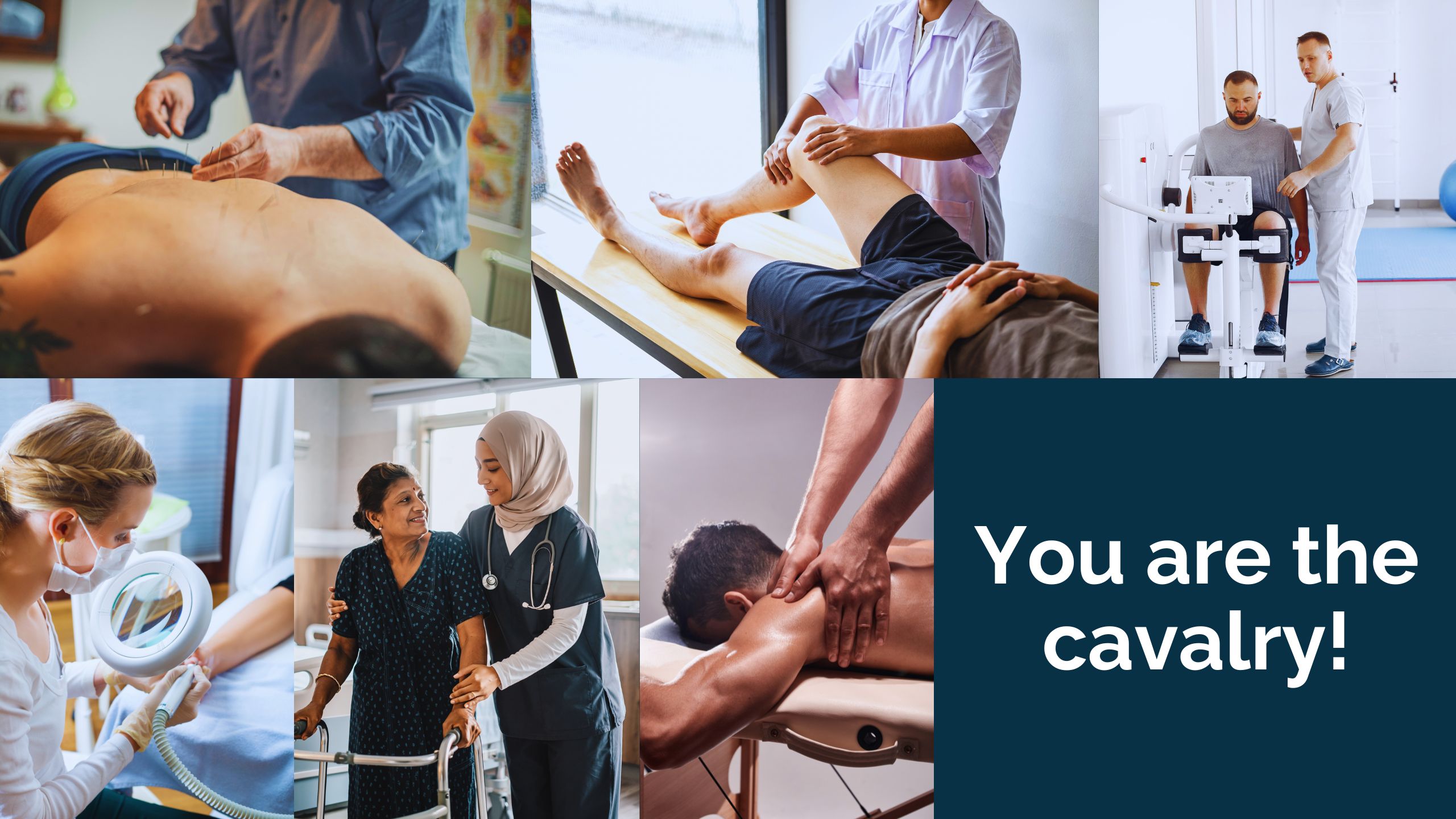
One of the most important decision you can make as a practice owner is not which marketing strategy to try or which software to use. It's simply the decision to take your practice seriously as the community health asset it truly is, and to commit to helping it reach its full potential.
Not to build something enormous and not to chase growth just for the sake of it. But to stop playing small and to aim to help as many people as your practice is genuinely capable of helping. To create the kind of career and business that actually rewards the huge commitment of time and energy you have already made.
I really want to encourage you to make that decision today. Not tomorrow, not when things quieten down, not when you feel more ready. Because I truly believe you are the cavalry. You and practitioners like you, working in treatment rooms, clinics and communities every day, are already part of the solution to one of the biggest healthcare challenges our countries face. The question is simply whether you are ready to embrace that and make that decision - to be the cavalry.
Making a new decision only takes a moment, but when you truly make one, something shifts. You stop dabbling and start committing, you stop waiting for the perfect situation and start working with the one you have. You hold yourself to a different standard because you have drawn a line and chosen which side of it you are now standing. That kind of decision can change so much, not all at once, but slowly and steadily.
It doesn't have to feel big or overwhelming either. The practitioners I work with learn to make small, incremental changes that compound over time. A pot of new pens at reception, a simple welcome process for new patients. One very part time administrator, a weekly Google Business post. A slightly fuller diary, a new service that did not exist six months ago. Tiny and small steps that don't have to feels seismic, but when you look back in twelve months time the difference can be extraordinary.
The challenge with any decision, of course, is holding yourself to it when life gets busy and old habits pull you back. That is not a character flaw, it is just human nature. And it is exactly why this should not be a solo endeavour.
I want to invite you to join our growing community of tiny healthcare practices that are already on that path - starting with the Practice Momentum Academy, our free community of practice owners who are learning together, supporting one another and holding each other to the decisions they have made. Me, my team and an extraordinary group of practitioners are in there every day, sharing what is working and proving that steady, purposeful progress is available to any practice willing to pursue it.
You have already made the hardest choice - you chose a career built around helping others. Now let us help you make the most of it.
Thank you soooo much for taking the time to stop by my healthcare marketing blog today. I really hope you found value in spending some time here today.
I’d be so grateful if you could spare me just another 5 minutes to share your thoughts or questions in the box at the end of this page. What are you going to do differently now in your private practice?
Oh, and please use the social share buttons if you think other people you know might benefit from seeing this.
Until next time.
Thank you
Jill Woods
Healthcare Marketing Specialist
Founder of Practice Momentum

Jill Woods
Healthcare Marketing Specialist | Founder, Practice Momentum | Author of ELEVATE
I started Practice Momentum in 2010 after watching too many brilliant clinicians quietly burning out — not because they were bad at their jobs, but because nobody had ever taught them how to run or market a small business. Since then, I've helped hundreds of tiny practice owners around the world build practices that are professionally exciting, personally fulfilling, and financially rewarding. I'm the author of ELEVATE: Mindset, Marketing and Happiness Strategies for Allied Health Practice Owners, a podiatrist turned healthcare marketing specialist, a speaker, a nomadic military wife, and a self-confessed happiness junky. I believe tiny practices have the power to change healthcare globally - and I'm on a mission to help as many of them as possible thrive.
