
All Change - The new Google rules for healthcare practice blogs

By Jill Woods | Healthcare Marketing Specialist | Practice Momentum
Google has released two significant core updates so far this year - in March and May. A core update is when Google makes major changes to how it decides which websites to show you and in what order when you search for something, and they happen several times a year. The March 2026 update is the one with the most specific and significant implications for healthcare practice owners - and in this post I'm going to break down exactly what changed, and how to use it to your genuine advantage. This applies whether you're running an owner-operated practice in the UK, Australia, South Africa or New Zealand - and it's genuinely good news.
If you started a blog for your practice, wrote a handful of posts, and then quietly let it fade into the background while you got on with the actual business of seeing patients - you are not alone. Not even slightly. Most practice owners I speak to are in exactly the same boat. So if that's you
a) don't feel bad and
b) pay attention - what I'm sharing today is genuinely good news. It comes directly from Google, and for once it's working in your favour.
🎁 There's a great free resource in this post
Scroll to the bottom and you'll find Your Pathology Blog Post Toolkit - a free two-stage prompt guide that takes you from blank page to a structured, research-backed draft using Claude. Built specifically for healthcare practitioners. Yours to download and keep.
Or keep reading first - the context will make it even more useful.
What Google just changed - And why it matters for you
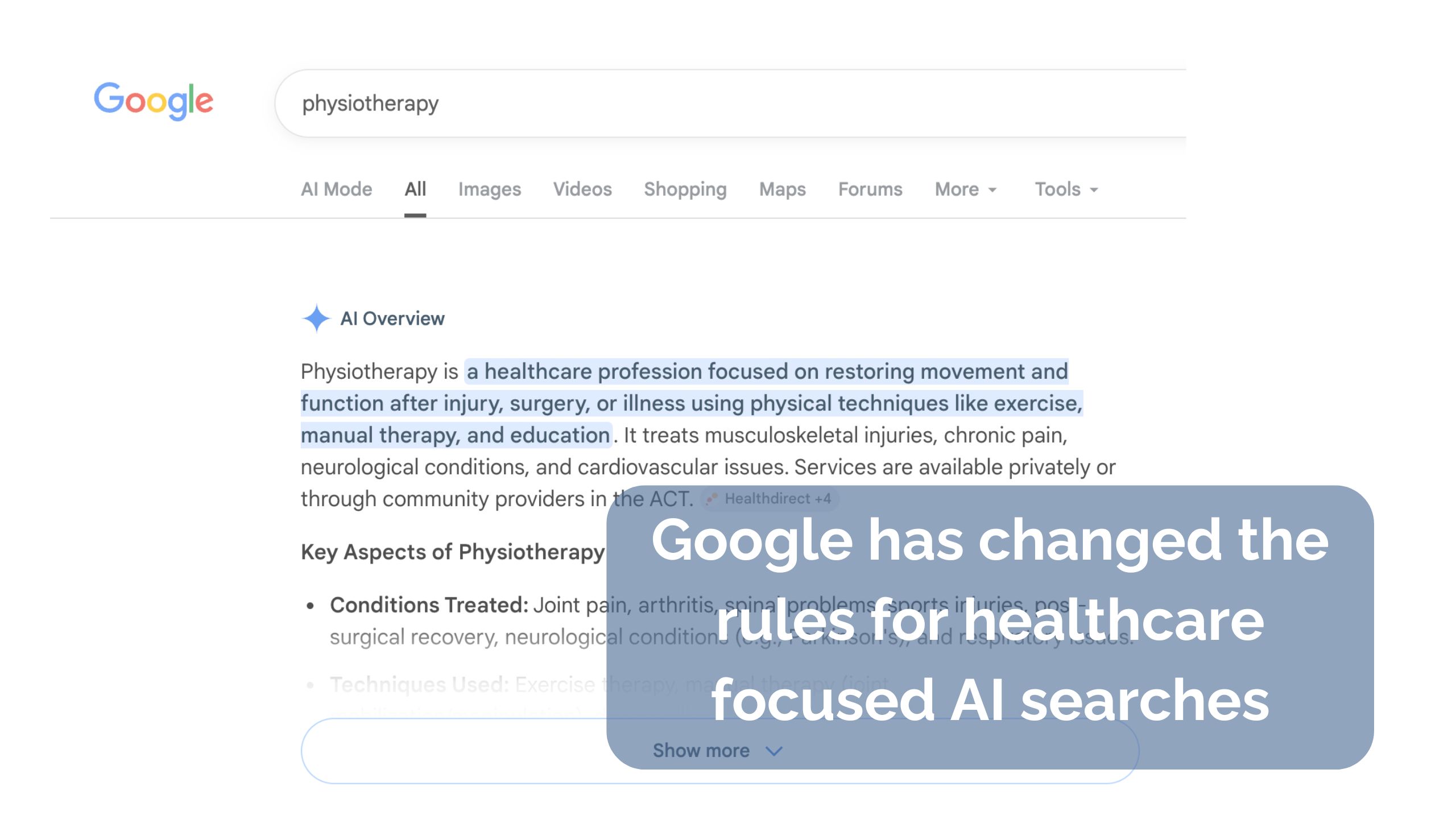 In March 2026, Google released one of its most significant core algorithm updates I have seen in recent years. If you follow digital marketing at all (and I'm not expecting you to 😁), you may have seen it mentioned. But most of the coverage has been targeted at large marketing teams, SEO agencies, and businesses with content creation departments - not you in your small practice. I haven't seen anyone else talking about what it means for an osteopath running a two-room clinic in Canberra - So this blog is aimed at fixing that. The central shift in Google's March 2026 update is this: Google has moved away from rewarding content volume and keyword density, and toward rewarding what it calls Information Gain - content that adds something genuinely new, written from genuine expertise, that cannot simply be found repeated all over the internet. The new guiding principle, stated clearly in the update, is that the ideal content length is whatever fully and expertly satisfies the search intent - not a word count target, not a keyword density score, not a post that hits 2,000 words by padding out the middle third with things nobody needed to read. This is brilliant news because it totally kills generic "Top 5 Health Tips" type posts with no original thinking. Content that says the same thing as the ten other pages already ranking on page one for that term is about to die. Blog posts written to please an algorithm rather than to genuinely help a person - your potential patients struggling with a very specific problem - is going to be penalised. This new approach rewards your first-hand clinical experience, real answers to real patient questions and content written by a named practitioner with a verifiable track record, drawing on years of genuine expertise in their field.
YEYYYY 🎉 finally you get a boost for being the great practitioner you are 🥳.
Read that again - because if you are a credible practitioner with a great local reputation, running your own small practice, Google's March 2026 update is giving you a golden opportunity 🌟
The rise of AI search - And what it means for your blog
 At the same time as Google was updating its core algorithm, something else was happening that you have almost certainly noticed as a patient yourself, even if you haven't thought about it from a marketing perspective. People are no longer just Googling, they are asking a handful of AI based platforms for answers. They are typing full questions into ChatGPT, Perplexity, as well as Google - and getting direct answers, without ever clicking through to a website. AI Overviews now appear in more than 50% of all Google searches, and that number is only going in one direction. This might sound alarming. If patients get their answer from an AI summary and never visit your website, what's the point of having a blog at all? Here's the point: AI tools are built to function using written content. They are trained from it, they synthesise it, and more importantly - they cite it. When an AI Overview pulls together an answer to a patient's question, it is drawing from sources it considers credible, expert, and trustworthy. Content that demonstrates genuine experience and expertise. Content written by named, qualified practitioners in their specific field. The goal of having a blog has shifted. It used to be to rank on page one of Google, get clicked on, get found. Now it's broader than that: to become a trusted, citable source that shows up whether a patient is searching traditionally or asking an AI platform a question.
Your blog content is no longer just your search engine strategy. It is your credibility infrastructure.
📢 Update — 21st May 2026: Google held its annual I/O developer conference and announced what it's calling the biggest upgrade to Google Search in 25 years. AI Mode - a fully conversational, Gemini-powered search experience - is now live globally. The direction of travel is no longer a prediction. It is happening right now. I'll covered exactly what this means for your practice and your website content in our Smart Marketing Workshop - AI Search - Showing up
. [You can purchase the recording here →]
Healthcare AI search results were proven to be dangerous
Next I just want to share something else that didn't make many headlines outside of specialist digital marketing circles - but I want you to understand. In January 2026, following an investigation by The Guardian, Google removed or altered the structure of its AI Overviews feature for a number of health-related search queries. The reason was deeply concerning: the AI was providing misleading and in some cases clinically dangerous medical information. Research conducted at the time found that only 34% of AI Overview citations for health queries came from reliable medical sources - with YouTube cited more frequently than any hospital or clinic website. Academic research and peer-reviewed journals accounted for just 0.48% of citations 😳. Google's response was to significantly tighten what it calls E-E-A-T signals - Experience, Expertise, Authoritativeness, and Trustworthiness - specifically for health-related content. In practical terms, content without clear, verifiable signals of genuine expertise is increasingly being filtered out, regardless of how well optimised it is. This has created something genuinely significant for small practice owners - a GOLDEN opportunity! There is a credibility gap in health content online - and you're so well positioned to fill it.
A named physiotherapist, osteopath, speech and language therapist or podiatrist writing from ten or fifteen years of genuine clinical experience, under their own name, and attached to a real registered practice - that is precisely the kind of content both Google and other AI based platforms are now actively looking for in the health space. The giant content farms (yes that is a thing) and generic health websites cannot replicate that. Your lived clinical expertise is not just a nice differentiator, right now, in 2026, it is a genuine competitive advantage 🥳.

What good content actually looks like now
OK let's get practical - I want to share with you exactly what you need to do to get this change working to your advantage. Essentially you need to write under your own name, with your credentials visible (I'll show you how in a second). Google's algorithm now actively checks author identity and professional track record. Your name, your qualifications, your professional registration, and your years of experience - these are no longer vanity elements, they are now very important ranking signals.
Let that sink in for a minute - read it again if you need to - your credibility as a healthcare professional, not keywords, is now very important 🌟
Just a quick note here - this doesn't just have to be just you, it could be any of your clinical team members - or it could be you in collaboration with someone helping you with your content creation - BUT it's a real clinicians name that needs to be attached to the blog post as the author. NEVER JUST SOMEONE WRITING ON YOUR BEHALF. Every blog post needs an identified professional clinician author that can be verified as a real person.
⬇️ Here's exactly how you do it ⬇️
🌟 Showing up as a credible author - Without feeling like you're bragging
On every blog post, you need three things:
1. A simple byline at the top Just your name, your title, and a link to your author page (I'll explain what that is in a minute). Nothing more needed here.
Example: By Sarah Mitchell | Registered Osteopath & Founder, Coastal Osteopathy
2. An author box at the bottom of every post This is where your credibility shines - but write it like a human, not a CV. Top Tip: Create this in a document so you can copy and paste into every blog post to save time.
You need to include:The test: Read it back. If a generative AI could have written the same bio for any other practitioner in your field, it's not specific or personal enough. Make it unmistakably you - with some personality and elements that are uniquely you.
- Your full name and professional title
- How many years you've been in practice - specificity matters
- One sentence about why you do what you do - your origin story in brief
- Any published work, media appearances or speaking you've done - If there is a big string of them chose the 3 or 4 most recent or credible
- A photo - a real one of you in your practice, not a stock image, or one generated by AI
- Links to your LinkedIn and professional registration body profiles
3. A dedicated author page on your website This is the piece most small practices skip - and it's the most important one for Google. A standalone, indexed page about you as an author and connects all the dots: your website, your social profiles, your book or publications, your community mentions, your real-world presence. Every post byline (see point 1) should link to it. What your author page needs:What to avoid:
- A professional photo
- Your full story - not your CV, your story. How you got here, why you chose your profession, why you love what you do, why you are based where you are, what you love about your team etc - a very personal back story.
- Your specific area of expertise and the conditions or patients you work with (or want to work more with). Don't list everything just the key pathologies.
- Any books, guides or resources you've published
- Links to your LinkedIn, Instagram or professional body profiles
- A selection of your best posts, linked from your blog
- A video or two that help showcase your work and your credibility
- A closing sentence that invites the reader to take the next step - whether that's booking an appointment, joining your community, or simply getting in touch.
- A long string of post-nominals nobody outside your profession recognises
- Writing in the third person if it doesn't feel natural
- Using a generic headshot or, worse, a logo instead of a real photo
- Leaving the author field in your website settings blank or set to "Admin" - this actively hurts your credibility with Google

- One small thing that makes a big difference: Add a "Published" date and a "Last updated" date to every post. For health content especially, Google uses content freshness as a trust signal. A post you reviewed and updated in 2026 signals something very different from one that hasn't been touched since 2021.
- Answer one real question, completely per blog post. Not ten questions superficially. Think about the question your patients ask you most often in the first appointment - the one where you find yourself giving the same explanation every week. Write that explanation down, clearly, as if you are talking to a patient in your waiting room. That's a blog post.
So "How long does it take to treat X" NOT "Everything you need to know about X" - Write from your clinical experience, not from what other websites say. This is the Information Gain principle made practical. If your post is a reworded version of something already on the NHS website or a professional association page, it adds nothing. If it draws on your genuine clinical observations, your patient experience, your specific local knowledge, it adds something nobody else can replicate.
- Structure your post clearly. Use plain headings. Answer the most important part of the question early, not buried at the end. AI systems extract passages from content to build their summaries - a clearly structured post makes it easy for them to find and cite your best thinking.
- Length follows completeness, not a target word count. A thorough 800-word post that fully answers a specific patient question is more valuable than a padded 2,000-word post that loses the reader halfway through. Write until the question is genuinely answered. Then stop.
- Reference credible sources where relevant. Links to NICE guidelines, national professional standards, peer-reviewed research relevant to your specialty - these strengthen your trustworthiness signals and demonstrate that your content exists within a professional framework.
- Consider adding a single multimedia element. Even a short video introduction, a downloadable patient handout, or a relevant infographic elevates a post considerably - both for the reader's experience and for how AI systems assess content richness. (If you want to understand the full power of multimedia in a practice blog, I covered this in depth in my 2024 post — Do You Still Need a Blog? — which is still as relevant as ever for the foundations.)

Here is my no nonsense Yorkshire bit, because most blogging advice is written by people who have never tried to do it while also running a full clinical caseload 😁.
You do not need to blog weekly.
You do not need a content calendar with twelve categories and a publishing schedule that makes you stressed just looking at it.
What you need is a system simple enough to actually maintain.
Start with the ten questions your patients ask you every single week. Write them down after your next clinic day - the ones where you find yourself giving the same answer, the ones that come up in every new patient assessment, the ones where you think "I've explained this a hundred times." That list is your content calendar for the next ten months.
Commit to one well-written, expert post per month. Not ten posts next month followed by silence until guilt kicks in again. One post, twelve times a year, written properly. That is 12 permanent, searchable, citable answers to questions your next patients are already asking - answers that work for you at midnight, when you are on holiday, and on the days when you're flat out in the practice.
Think of each post as a business asset, not a task. Your blog is the only piece of digital real estate you truly own. Social media platforms change their algorithms, freeze accounts, and can disappear. (Our Practice Momentum YouTube channel was suspended for over two years for no reason what so ever - we got it reinstated eventually, but the lesson was painful.) Your website will always be there. Your blog content compounds over time.
And if you're wondering exactly how to write that first post - I've included a fantastic free resource further down this page that will help. So keep reading 🤩.
A note just for tiny practices
I want to speak directly to a group that I think about constantly - the practitioners that make up the Tiny Practice community. The solo physio, osteo or podiatry practice. Or the two-person counselling, speech therapy or multidisciplinary practice. You are not competing with large private group practices on marketing budget. You never were, and you don't need to. What you have that they don't is this: you are a real, named, locally known clinician with genuine expertise and a genuine connection to your community. In a world where Google and AI platforms are actively trying to find and share credible, expert, experience-driven health content, and actively filtering out the generic noise, that puts you in a brilliant postition. The practitioners I see thriving with their content right now are not the ones writing the most. They are the ones writing the most specifically. A post titled "What to expect from your first appointment at [Your Practice Name] if you have [specific condition]" will consistently outperform a generic post titled "Top 5 Tips for a Healthy Back." Not because it's longer, but because it's real, it's specific, and nobody else on the internet can write it. That is the Tiny Practice advantage. And it has never been more relevant than it is right now.

All it takes is one quality post a month and you will find your content showing up online when people in your area are searching for the kind of expertise you have. BUT I get it - I can here you - "That all sounds great Jill, but where or how do I actually start?" No worries at all - I've got you covered - START HERE ⬇️
I've created a free resource - Your pathology blog post toolkit
It's going to help you kick start your next pathology based blog, using Claude to do the heavy lifting.
It's a really simple two-stage AI prompt guide that tells Claude exactly what to research, how to structure your post, and how to write it in a way that works for Google, AI search, and most importantly, your next patient. You bring the clinical expertise and the case study. Claude does the drafting then you make it sound like you.
Download Your Pathology Blog Post Toolkit - HERE free
If you don't have a Claude account yet you can get one here A quick note on which AI platform to use - the toolkit is written for Claude, which is what I use and recommend for copywriting tasks. In my experience Claude produces warmer, more natural written content than ChatGPT, and handles long, detailed prompts like this one more reliably. That said, if you're already a ChatGPT user the prompts will work there too - you may just need to do a little more editing.
OK that's it. You now have everything you need to write a blog post that genuinely works for your practice, your patients, and the search platforms that are increasingly shaping how people find healthcare.
If you found this useful and want to go deeper on building a blog and content strategy that actually works for a small healthcare practice, my book ELEVATE: Mindset, Marketing and Happiness Strategies for Allied Health Practice Owners covers this and much more. Available on Amazon UK, Amazon AU, and internationally. And if you're not yet part of our free Practice Momentum Academy community, come and join over 640 other practitioners who are building thriving tiny practices on their own terms - practicemomentum.org
Jill Woods x

Jill Woods
Healthcare Marketing Specialist | Founder, Practice Momentum | Author of ELEVATE
I started Practice Momentum in 2010 after watching too many brilliant clinicians quietly burning out — not because they were bad at their jobs, but because nobody had ever taught them how to run or market a small business. Since then, I've helped hundreds of tiny practice owners around the world build practices that are professionally exciting, personally fulfilling, and financially rewarding. I'm the author of ELEVATE: Mindset, Marketing and Happiness Strategies for Allied Health Practice Owners, a podiatrist turned healthcare marketing specialist, a speaker, a nomadic military wife, and a self-confessed happiness junky. I believe tiny practices have the power to change healthcare globally — and I'm on a mission to help as many of them as possible thrive.
